
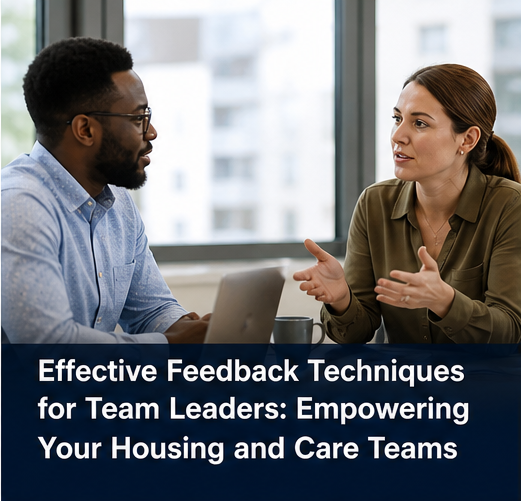
In the fast-paced world of housing and care, the monthly 1-to-1 is a familiar fixture in
every manager’s diary. Yet, all too often, these meetings become “tick-box”
exercises—focusing purely on rotas, compliance, and task lists.
While paperwork is essential for safety, the most successful team leaders use this
time for something much more powerful: meaningful feedback. At Dynamic
Motivation, we know that in high-pressure roles, feedback isn’t just about correction;
it’s about making your staff feel seen, supported, and skilled. Here is how to
transform your feedback from a “telling off” into a tool for empowerment.
- Master the SBI Model for Objective Clarity
Vague feedback like “you need to be more professional” or “your attitude needs to
improve” is the enemy of progress. In care and housing, where staff give their all
emotionally, vague criticism feels like a personal attack.
To keep your 1-to-1s productive and stress-free, use the Situation-Behaviour-
Impact (SBI) framework:
Situation: Anchor your feedback in a specific moment. “During the resident’s
assessment yesterday morning…”
Behaviour: Describe only what you observed. “…you spoke over the tenant
while they were explaining their concerns.”
Impact: Explain the result. “…this caused them to shut down, and we missed
key information for their care plan.”
Sector Insight: Link the impact directly to service-user outcomes. When a staff
member sees that their communication style directly affects a resident’s comfort or a
tenant’s safety, the feedback shifts from “management rules” to “fulfilling our
mission.”
- The Golden Rule: Public Praise, Private 1-to-1 Correction
The “when” and “where” of feedback are just as important as the “what.” In busy
communal spaces—like a care home lounge or a housing hub—the wrong timing
can destroy morale.
Praise Publicly: If a Housing Officer successfully de-escalates a conflict on a
Tuesday, don’t wait for the 1-to-1. Celebrate it in the morning huddle! It
validates their skill and sets a high standard for the whole team.
Correct in the 1-to-1: Save corrective feedback for the privacy of your
monthly catch-up. This preserves the staff member’s dignity and ensures they
are in a mindset to listen and learn, rather than defend.
- Move from Monologue to Dialogue
A 1-to-1 shouldn’t be a manager reading a list of errors. In our sector, there is often a
valid “why” behind a performance dip—such as burnout, resource scarcity, or a
misunderstanding of a new protocol.
Practical Tip: After sharing your observation, ask an open-ended question:
“I noticed the handover notes have been a bit brief this week; what’s the biggest
barrier you’re facing during your shift that’s making that difficult?”
This turns you into a collaborator who removes obstacles, which is essential for
retaining talent in high-pressure roles.
Case Study: The “No-Surprise” Annual Appraisal
A regional provider managing both supported living and social housing noticed that
their formal annual reviews were causing high anxiety. Staff felt the feedback was
“stale,” and managers struggled to remember achievements from months prior.
The Intervention:
They didn’t scrap the formal annual review—they simply changed how they used
their monthly 1-to-1s. They introduced a “Progress Log” where one specific “Win”
and one “Growth Area” were recorded every single month.
The Outcome:
A Fair Reflection: By the time the formal annual review arrived, it was simply
a summary of twelve months of documented growth. There were no “shocks”
or “surprises.”
Audit-Ready: The organisation had a robust paper trail of staff development,
which was highly commended during a regulatory audit.
Better Morale: Satisfaction scores rose by 18% because staff felt their daily
efforts were being “seen” all year round, not just once a year.
- End with a “Forward-Focused” Action Plan
Feedback without a “next step” is just a conversation. Every 1-to-1 should conclude
with a clear goal for the following month that builds confidence.
Keep: What strengths should they double down on? (e.g., their fantastic
rapport with difficult tenants).
Start: What new skill will they focus on? (e.g., attending a workshop on
trauma-informed care).
Unique Insight: Investing in your staff’s skills is the ultimate form of positive
feedback. It shows you believe in their future within the sector.
Transform Your Leadership Today
Effective feedback is the heartbeat of a motivated team. By refining your monthly 1-
to-1s, you build a workforce that is not only compliant but truly inspired to make a
difference in the lives of those you serve.
Ready to upskill your management team?
Dynamic Motivation Ltd provides bespoke workshops and coaching specifically
designed for the unique challenges of the housing and care sectors.